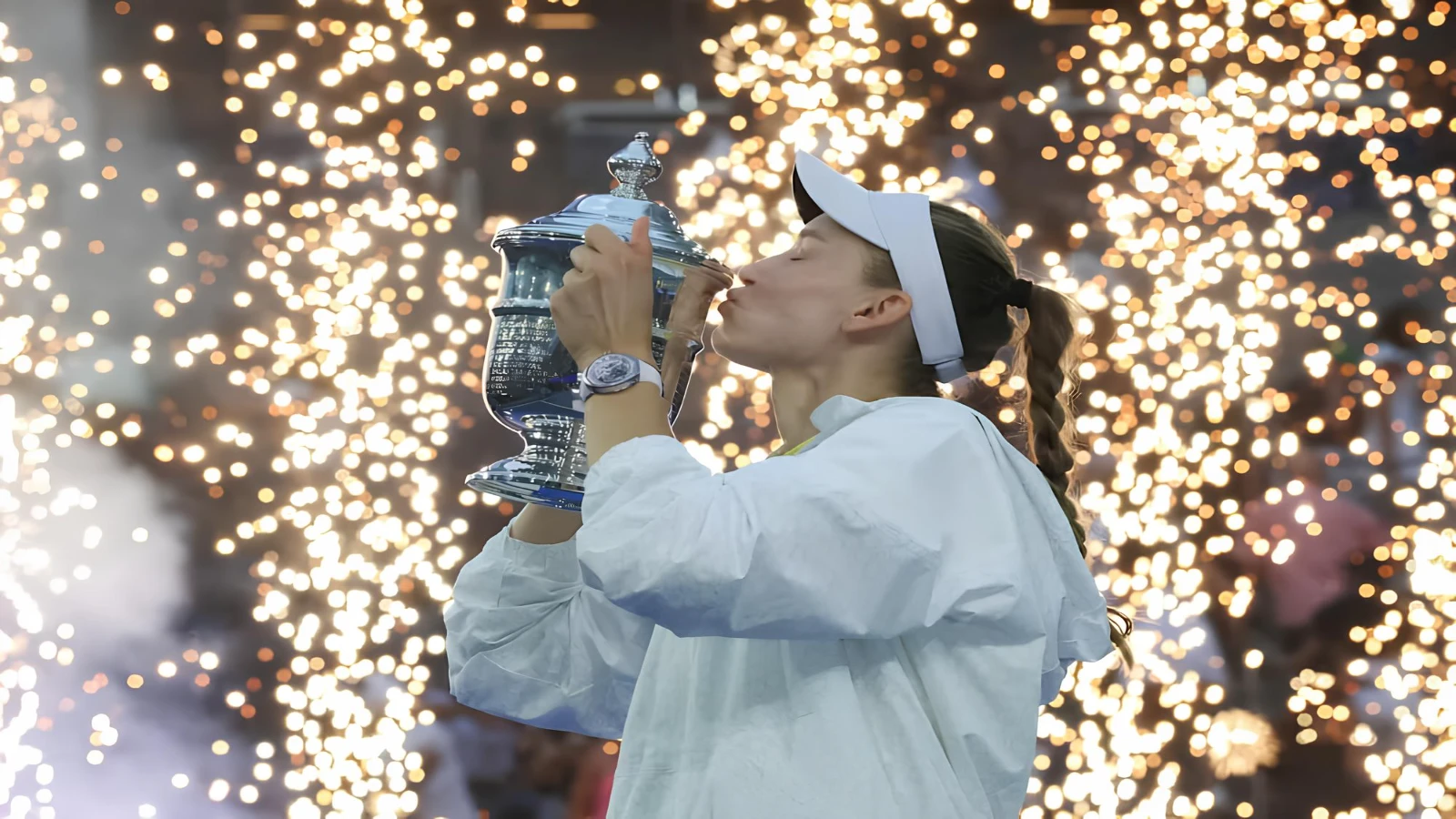
Elena Rybakina becomes the world No. 1 on Monday, when the WTA rankings publish for the first time since the US Open. She is the 30th woman to hold the position since the rankings began in 1975 and the first player from Kazakhstan, man or woman, to reach it. At 27 years and 89 days, only Angelique Kerber was older on getting there for the first time.
The 6-4, 5-7, 6-2 win over Aryna Sabalenka in Saturday's final did not decide any of that. It was settled on Wednesday, when her quarter-final win over Zheng Qinwen made the ranking mathematically hers, as we reported before the semi-finals. What the final decided was whether she would arrive at the top with the trophy or without it. She arrived with it, and with an ace, her 12th of the match, at 110 mph.
The ranking rewards a body of work, and hers is uneven in a way that is more interesting than a coronation. Since the end of last year's US Open she has won more matches (62) and more titles (four) than anyone on the tour, according to the WTA: Ningbo, the WTA Finals, the Australian Open and Stuttgart. Two of those came against Sabalenka in finals, the Melbourne one from 3-0 down in the deciding set. At the end of 2025 the gap between them was 9,870 points to 4,350. By New York it was 414.
The middle of the year told a different story. She went out in the second round at Roland-Garros to Yuliia Starodubtseva, then lost at Queen's, in Berlin, and in the third round of Wimbledon to Elise Mertens, 7-6, 6-1. "If I knew why, I wouldn't be in this situation right now," she said in London. "Definitely I need to analyse and change something, because it's not working."
What changed was the surface, and how much she was prepared to suffer on it. In Toronto four of her matches went three sets, including recoveries from a set down against Naomi Osaka and Coco Gauff, and she spent close to eleven and a half hours on court before losing the final to Iga Świątek. In Cincinnati she needed to reach the final to pass Sabalenka. She came out for the quarter-final against Świątek with her left ankle taped, trailed 1-4, and retired after 30 minutes. "It's been bothering me for a long period of time," she said. "It was under control, but then after playing a lot of matches in Canada and coming here playing two matches in a row."
She arrived in New York not knowing whether the ankle would hold for a fortnight. "It was not ideal, and I was stressed, of course," she told the WTA after the quarter-final. Then she won four rounds without dropping a set, one of them against Starodubtseva, beat Osaka for her first US Open quarter-final, came from a set down against Zheng and again against Gauff, and beat Sabalenka having landed 27 per cent of her first serves in the opening set. Three former champions, one ankle.
Highlights via the US Open's official channel
Sabalenka's 99 consecutive weeks at No. 1, which began in October 2024, will stand as the sixth-longest unbroken stay in the history of the rankings. She reached a final here for the third year running and lost to the player who had already beaten her in the WTA Finals in November and the Australian Open final in January. "Not good enough," she said afterwards, and left it there.
Rybakina put it more slowly. "The No. 1 ranking is, of course, one of the goals," she said on Wednesday. "But the main focus for me, for the team, is to win the titles, and then the ranking will follow up." On Saturday it did, in that order.